Friday, June 29, 2012

Animals on the Hill

Nanny Flynn holding my mother Mary, summer 1930 with Daisy the Ayrshire Cow
Aunt Agnes tells me about the animals they raised and cared for while growing up on Flynn's Hill. They had chickens for eggs and poultry, and a horse to help with the plowing and hauling. They had a couple of pigs along with a cow for milk. She explains, they were very fond of the cows, remembering "Daisy" especially.  They would not let their parents sell her or send her to be butchered.  Much of their time was spent feeding and tending to the animals. 

She told me, "Dad would go down to the Bay", Bay Roberts that is, which was about 30 km (19 miles) from Harbour Main to buy a horse, paying $20.00. Twenty Dollars was alot of money in those days especially during the Great Depression. A white horse named "Jack" was one of their favorites.  They had only one horse at a time on their small farm.  The horse stayed up in the "pen" on the hill during the summer and in the stable during the winter.  George, her brother would take the horse down to the pond across from their house for water.

Aunt Agnes recalls an occassion when my mom got up on the horse and George hit the horse on the "rump".  The horse took off going a "mile a minute" with my mom hanging on. He did not stop until he got to Hawco's Forge,  the place where he had been shoed at one time. Aunt Agnes and her siblings chased after the "Runaway Horse" and caught up with him, consoling their sister and bringing her home. Aunt Agnes states my mother was very upset at the time, very upset to say the least. But knowing my mother, I know she would laugh at this story today.

 I would of loved to hear Uncle George's version of "The Runaway Horse".

Uncle Ray (abt 13 years) with their young cow.

Thursday, June 21, 2012

The Root Cellar

Ellen Mary Tobin Flynn - My Grandmother


..
In this photo, the small open door behind my grandmother was the mysterious luring Root Cellar.

 You could access the root cellar through this door from the outside or from a door in the back hallway of the house. This darken place evoked great curiosity for me as a young girl, wondering just what could be in there. I remember clearly when Grand Dad or Nanny would open the door a wave of cool air would come surging out encircling my little body.  I was never allowed to go into this space, I could only stand at the threshold and peer in.  I can remember a long electrical wire leading to a single hanging light bulb, and when the power string was pulled it gave this room minimal lighting but showed the detail of numerous spider webs. As Grand Dad proceeded in, I waited impatiently at the doorway.

A Root Cellar on the back of the house is something not seen these days. But for the Flynn Family in the 1930's -1960's it was a necessity in preserving their food especially with no refrigeration.  Aunt Agnes tells of how  they stored vegetables from the garden,  beef and pork salt meat, and coal for the heat stove, all for the long winter months. There was also an area where their father kept some tools like the grinding stone for the ax. As children they did not like going into the Root Cellar, being scared of the mice that may of lived in this dark place. When I questioned her as to how she knew for sure there were mice in there. She stated, that when the door would be opened they would see the mice scurry away and they could hear the mice at night scratching in the walls.

So, there you have it, the mystery of the Root Cellar, vegetables, salt meat, and coal along with tools, mice and spiders.

Thursday, June 14, 2012

Gardening on Flynn's Hill

My 2011 Garden in Wisconsin - featuring "Rapunzel the Scarecrow Lady"
Made by Avery my Grand Daughter and my Great Niece Skylar
with a little help from Brian my son.

My grandparents grew vegetables on Flynn's Hill to sustain there family of seven.  Their harvest of potatoes, parsnips, turnips, carrots, cabbage and beets were stored for the winter in the Root Cellar.  The Root Cellar was built on to the back of the house right into the base of the hill, so that the back wall was the earth itself.

The gardens were in several locations around their property, things like lettuce, beets and carrots were planted in an area toward the front of the house. Potatoes, turnips, parsnips and cabbage were planted "inside the meadow" up past Bill and Nell's place, according to Aunt Agnes. Newfoundland has a very rocky terrain making it impossible to have large planting fields.

Most things were started from seed.  But turnips, she remembers came from small starter plants which were bought.  I imagine tomatoes were bought as small plants as well, to get a jump start on the very short growing season of Newfoundland. The tomatoes needed to be picked while they were still green and brought inside before the frost to ripen.

Potato planting began from leftover potatoes from the previous year.  Taken from the Root Cellar, they were cut into pieces so that an eye of the potato was exposed on each piece. They then sat for 3 weeks to "cure" before planting. Aunt Agnes states she remembers her sister Mary, my mother, helped their father plow the field in preparation for planting. Her job was to lead the horse while their father followed behind with the plow to make a "drill" or trench.  The potato pieces were placed in the "drill" with the eye facing upward.The children were responsible for digging up the potatoes in the fall. Occasionally they would miss school in order to get this done before the winter set in.

Lastly, Aunt Agnes tells me about the "Cherry Garden" which was located behind their house.  Her mother had a strawberry and rhubarb patch along with a Cherry and Plum Tree ( Damson Plums). Sweet Rewards for all their hardwork!


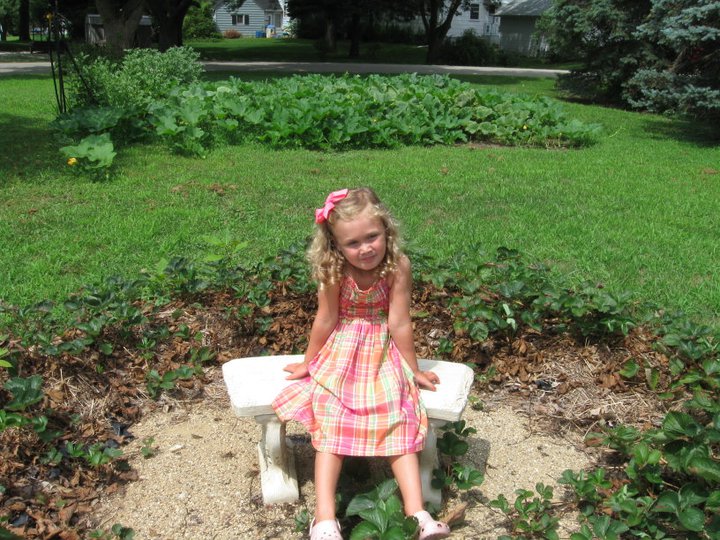
Avery Elizabeth Clark
sitting in her Nana's Strawberry Patch


Friday, June 8, 2012

My Roots

My Golden Retriever, Lucy

Lately, my focus has been immersed in getting my vegetable garden started, and not on posting entries to my family history blog, especially with the extremely wonderful Wisconsin weather we are having now.

Growing my garden is a ritual for me that has developed over the years. I find a lot of enjoyment and satisfaction in producing my own vegetables, it is so simple but yet very rewarding.  I learn something every year in the garden, whether it be about spacing and watering, or about patience and timing, one just needs to pay attention and be aware.

For me, it is also a place to get lost in thought or even clear my head, it is a connection with the earth.  In the garden, there is no drama or politics just straight forward simple life.

 I remember as a young girl always wanting to grow things, but living in many different apartments throughout my childhood made it impossible. Around age 12, I was finally given a flower box that sat on the edge of the cement patio. In this box, I would plant orange marigolds, this made me very happy!  Today, I continue to plant them around the edge of the garden to keep the rabbits out!

Gardening is not something I was taught but something that came from within, it was a strong interest I had. Aunt Agnes tells me, it is part of my "Newfoundland Heritage".  Gardening was their way of life growing up, necessary for surviving.  They were taught as young children to tend to the garden, and much of their time was spent on this task.  They grew potatoes, cabbage, and turnip, also lettuce, carrots, and beets.  I imagine this was quite a challenge considering the short growing season of Newfoundland and the rocky composition of the soil. 

My next blog, " Gardening on Flynn's Hill" notes from Aunt Agnes

Lucy loves to make rounds with me early in the morning, checking the progress of the garden.

Thursday, May 10, 2012

Icebergs and Whales


It currently is Iceberg Season in Newfoundland, there are many locations along the North and East sides of the island to view icebergs and whale watch. This little video features a boat tour from St. Anthony, located at the Great Northern Peninsula. Come Along!  Let's Go!

Monday, May 7, 2012

The Shamrock School

                                                                                                                                                                                           [1]

For much of Canada's history and well into the Twentieth Century, many of Canada's children were educated in one room, multi-grade schools. [2]   Education was not always a public concern in the Harbour Main District of  Newfoundland.  Those children who did attend regularly were interested in book learning but the majority remained home to work with their parents either fishing or farming. [3]  The Shamrock School in Lakeveiw Harbour Main District stood at the junction of two roads, a site known locally as "Fardy's Cross". [4]   Aunt Agnes said, she believes there was a family named Fardy in the community and possibly it was their land the school had been built on.

This junction of two roads with a Cross, is also the location of The Old Irish R/C Cemetery that I wrote about in the post dated 04/21/2012, which is  at Conception Bay Hwy and Harbour Dr.

The Shamrock School was built in 1908, the white clapboard building was forty feet in length, twenty feet wide with a high peaked roof and ceilings that were at least twelve feet in height.  At the back of the school was a large attached porch that served as the school's entrance, with hooks on its walls for the children's outer garments and a large coal bin situated at it's rear.  Also attached to the back of the school were two outhouses, one for the girls and one for the boys, and these were accessed through a short partitioned hall.  During the period of study, the school had electricity but no running water.  Thirty-five to forty students seem to have been the average number attending the school at any given time.

In the center of the classroom sat a pot-bellied stove with a sheet of metal beneath to protect the floor from sparks. It was here that mittens dried after a winter's recess.  On exceptionally cold and windy days, the stove was sometimes taxed beyond it's capacity, despite the zealous efforts of the older boys to stoke it until it was red hot.  At such times, the teacher would dispense with the orderly row of desks and allow them to be moved around the stove in a roughly circular fashion. so that the children could better share the limited heat.  The lack of a schoolyard did not pose a problem, for the ponds, the woods and Kennedy's meadow were all easily available, the children organized their own activities during recess.[5]

In 1908, when the Shamrock School was built, my grandfather Stephen was 13 years old, he was well passed the age to start attending school, receiving his education from life experiences working with his father and family.  After reviewing the education history of Harbour Main District, it seems that there were schools established in neighboring communities, but the distance was probably an interfering factor for my grandfather and his siblings to attend, including the generation before him. My mother shared the story that her father was taught to read and write by her mother, who had been a school teacher before they were married.  My grandfather was 32 years old, when they married.  Uncle Ray explained that during this time period in Newfoundland, if a person could read or write they would be placed in a managerial or foremen position, and in return received higher pay.

My mother and her siblings all attended the Shamrock School in the 1930's -1940's.  Mary Costigan, who is mentioned in the top photo, taught at the school from 1942-1947 The Shamrock School was phased out at the end of 1966-67 school year upon the centralization of schools in  Harbour Main Parish.  It was demolished a few years later and with its removal a familiar landmark in Harbour Main disappeared.[6]

[1] "Our People.... Our Church...." Sts. Peter and Paul Parish, Harbour Main, Chapel's Cove, Lakeview Newfoundland, 1857 - 1982, Copyright 1983 by Rev. J. Glavine, P.P. pages 68-69.

[2]   Pat Trites, "The School on Fardy's Cross" Shamrock School Remembered, Framing Our Past, Canadian Women's History in the Twentieth Century.McGill-Queen's University Press 2001, pages 184 - 188.

[3] Alice Strapp, "History of Harbour Main",  Newfoundland's Grand Banks Genealogical and Historical Data, http://ngb.chebucto.org/Articles/history-hm.sh , Education.

[4] Ibid [2]

[5] Ibid [2]

[6] Ibid [1]

Thursday, May 3, 2012

The Search


The process of collecting information for my Flynn Family History Blog has been most rewarding.  Especially the connections made with family members and the discoveries brought forth along the way.

After interviewing Aunt Agnes in California about her school days experience in Lakeview Newfoundland, I went online searching for additional information about The Shamrock School. My thinking was, " You just never know, what you will find".

 My search lead me to a Biannual Journal  of  Eastern Canada's History called ACADIENSIS, this journal contained a section listing new publications relating to Eastern Canada, the listing directed me to an essay written by Pat Trites in 2001 entittled,  "The School on Fardy's Cross" Shamrock School Remembered.  The essay was nestled in the book "Framing Our Past" Canadian Women's History in the Twentieth Centery, pages 184-188.  I was able to view these pages online to confirm that this was truely the Shamrock School that Aunt Agnes was speaking about and that my mother had told me about.  An unbelievable find, five pages about the Shamrock School!!!!!!!

The next step, getting a copy of this book for my own reference. I  started searching for a source to purchase this book, checking for the possiblity of an e-book download ,but no such luck. I did find a used copy of the book available through Amazon.com from a former library in Florida.  The book was described as being slightly used, but in good condition, library taged and labeled. It sounded perfect to me. I made the purchase, and 3 days later, I received this very informative treasure!

Stay tuned for my next post about "The School on Fardy's Cross" using this additional information.